 Padel React
When you have ten different things you want to fix in your padel game, nothing really improves. You split your focus, get frustrated, and revert to old habits the second a match gets tight.
That is the beauty of the Tiny Experiments framework (popularized by Anne-Laure Le Cunff): instead of setting a rigid, overwhelming goal, you make a simple, curiosity-driven pact structured as "I will [action] for [duration]." By narrowing the scope and putting a strict 21-day timer on it, you create space for real, measurable progress.
The 21-Day Pact
For three weeks, every single day at home or in the gym, I am committing to:
- 100 víboras
- 50 forehand volleys
- 100 two-ball wall tosses & catches (with tennis balls)
The goal is to drill the kinetic chain of these three movements until they become pure muscle memory. Depending on the day, I mix between shadow training, hitting with a racket, and pure mental reps—adding 1 visualization session for every 3 physical sets to lock in the neural pathways.
Day 3 Progress & Check-In
Today’s session was a solid, focused 45-minute grind. Looking back at the mistakes I logged on Day 1, I’ve already cleaned up several major leaks in my mechanics:
- Higher Preparation: My arm and elbow are staying noticeably higher in the setup.
- Sharper Footwork: My adjustment steps are shorter, quicker, and much more balanced.
- Forward Momentum: I’m transferring my weight forward into the shot rather than falling back.
- Fluid Follow-Through: Instead of stopping the swing short, I’m completing the víbora with a smooth, oval motion and engaging my wrist properly at contact.
Today’s Big Lesson: The Camera Doesn't Lie
And why reviewing your footage is a superpower
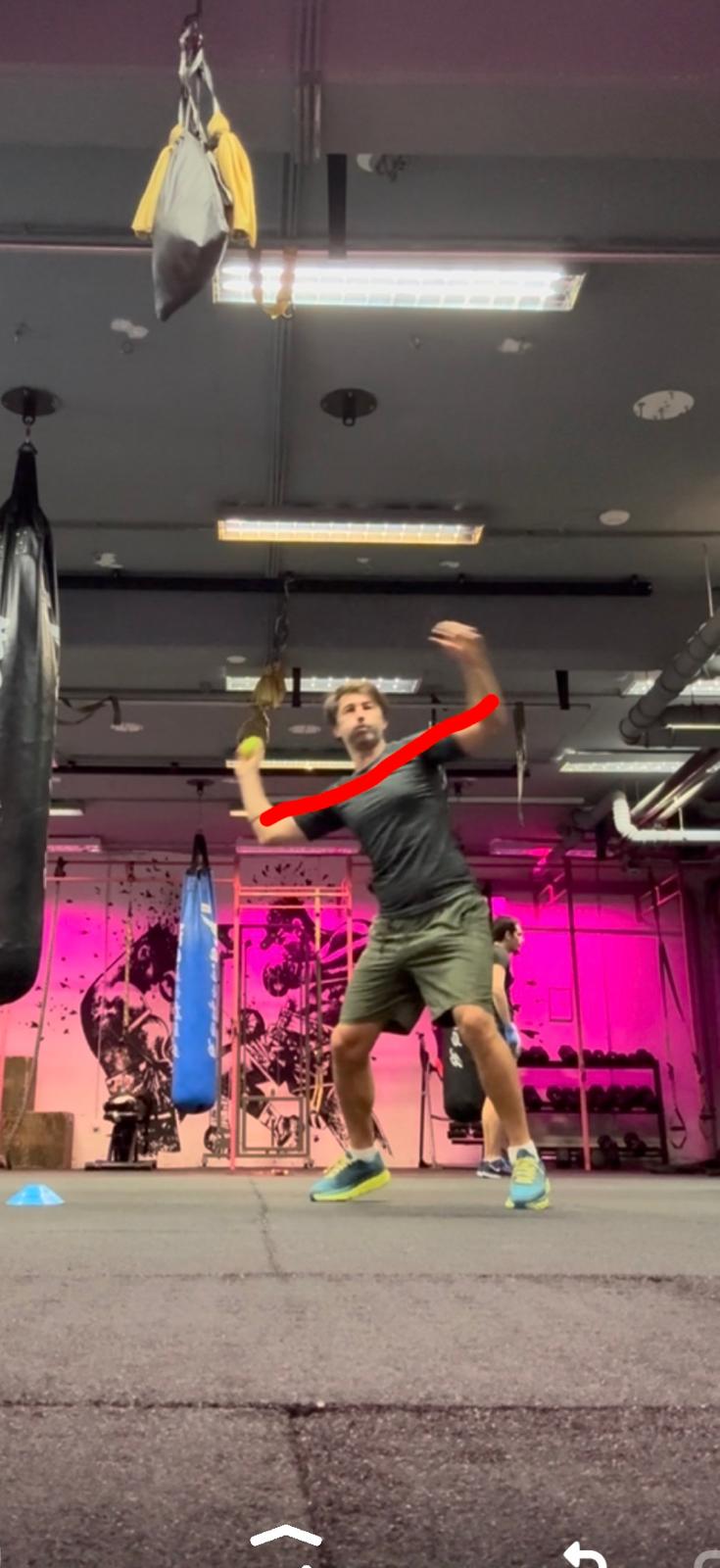
You can feel like your form is locked in, until you hit play on your training clips. While watching today's videos, one glaring habit jumped right off the screen: every single time I swing through the ball on my víbora, my left shoulder drops noticeably lower than my right.
It wasn't a one-off mistake—it was happening on repeat. Catching a blind spot like this on Day 3 is a massive win. When your non-dominant shoulder collapses early, you pull your head and torso off the ball, losing both stability and power. For tomorrow's session, my #1 priority is keeping my shoulders level through contact while holding onto all the footwork and elbow gains I've already made.
Training Adjustments for Tomorrow
Alongside fixing the shoulder drop, I noticed another subtle leak during my volley reps: I occasionally let my racket head drop during preparation, which adds precious milliseconds to my reaction time at the net.
To sharpen my reflexes and hand-eye coordination, I’m adding a new layer to my daily pact starting tomorrow:
- Continuous Two-Ball Wall Drills: Working rhythmically against the wall using two padel balls to force quick hands and high racket preparation.
- Eye-Patch Progression: Performing one of those wall sets while wearing an eye patch to challenge depth perception, visual tracking, and focus under constraint. Use a clear, non-slippery space and stop if you feel unsteady.
Watch Day 3 in Action
Here is a look at today's kinetic chain drills—from víbora footwork to shadow volleys:
I’ll be sharing how these off-court reps translate onto the padel court very soon. When you’re working on your own game, what is the one principle or drill you always anchor your practice around?
Read Day 1 of the 21-Day Padel Experiment.
See it calm, react fast.
Try Reaction Training